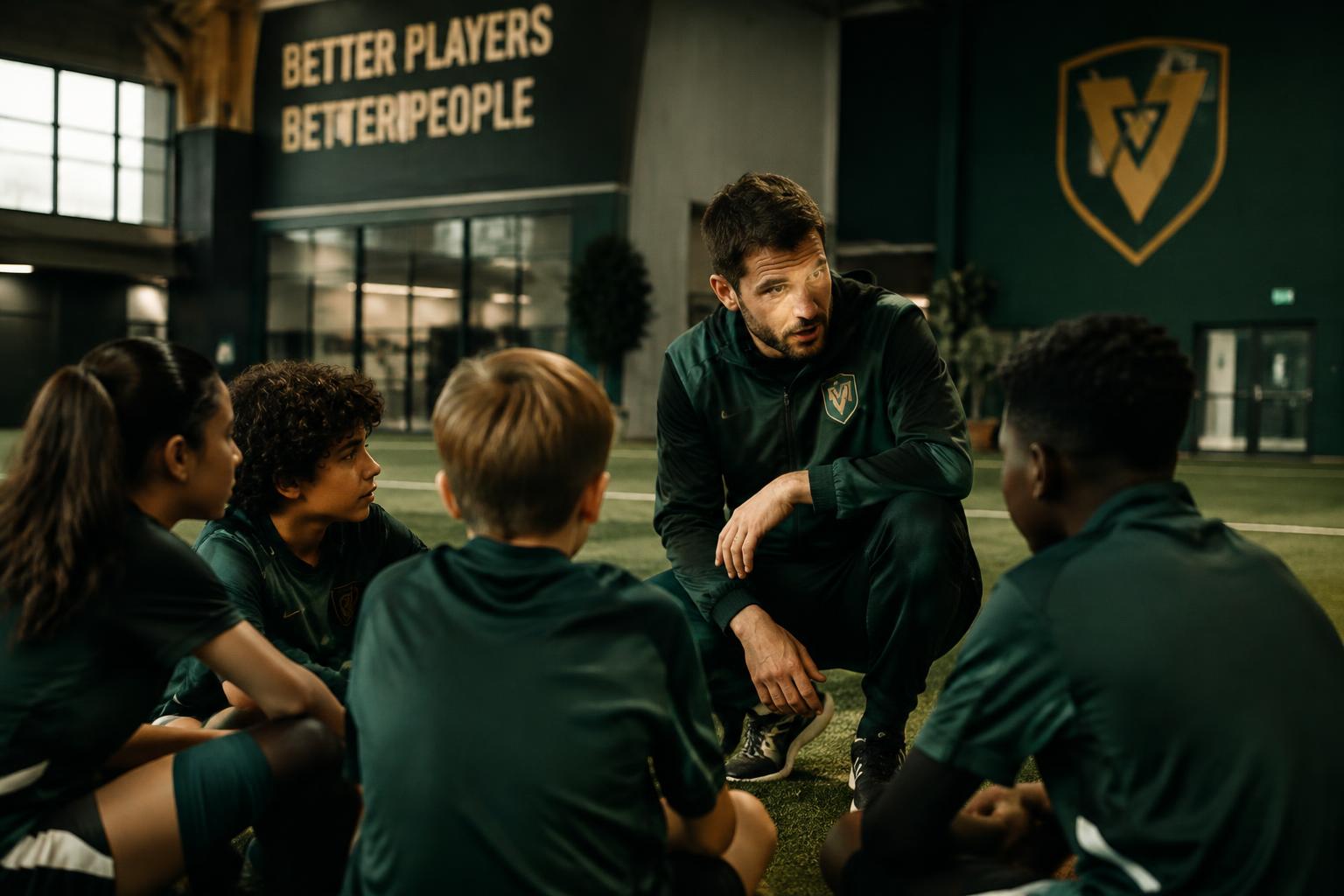
The Future of Our Kids Starts on the Soccer Field

Ask any adult who played as a kid what the game gave them, and almost nobody starts with trophies. They start with a coach who believed in them, a teammate who became family, a night they found out they were tougher than they thought.
A nine-year-old walks onto our turf on a Tuesday evening. School was hard. Her shoes are the wrong size. She doesn't know anyone. Forty minutes later she has completed her first successful turn under pressure, and she is looking around to see if anybody noticed.
We noticed. That is the job.
There is a version of youth sport that treats children as prospects — assets to be scouted, ranked, and moved along. We have all seen it, and we have all watched what it costs the kids who don't make the cut at eleven. Triple Kings was built on a different premise: the field is the most reliable classroom a community has, and every child who steps on it deserves to leave better than they arrived.
What a field actually teaches
Soccer is unusually honest. The ball does not care about your family's income, your accent, or your last report card. It rewards effort, repetition, courage, and the willingness to look foolish for a few weeks while you learn something new. Those are not sports skills. Those are life skills that happen to be taught with a ball.
In a single session a player will fail publicly a dozen times and recover a dozen times. They will be asked to communicate with someone they wouldn't normally sit with at lunch. They will be trusted with a role, and the team will feel it when they don't hold up their end. There is no worksheet on earth that does that.
This is why we are stubborn about our environment. Our indoor pitch runs year-round, which means the learning does not stop when the weather turns or the daylight goes. Consistency is the whole secret. Children become confident through accumulation, not inspiration.
"Children become confident through accumulation, not inspiration. Show up enough times and the belief has nowhere to go but up."
The part parents feel first
Parents usually notice the change off the field before they see it on it. Homework gets done without a fight because there is now a reason to finish early. Bedtime gets easier. A child who used to shrink in a room starts making eye contact. Six months in, a parent will pull a coach aside and say some version of the same sentence: they seem happier.
That is not a side effect. It is the point. We track touches, sprint loads, and technical benchmarks because measurement makes coaching honest — but we judge the academy by whether our players walk taller through the rest of their lives.
We also take seriously how much families are trusting us with. Three evenings a week is a real share of a childhood. So we make the standard high and the door wide: structured sessions, qualified coaches, clear communication home, and a scholarship pathway so cost never decides who gets to develop.
Why it matters beyond one child
A community's future is not decided in a boardroom. It is decided in the ordinary hours after school, in whether kids have somewhere to be that expects something of them. Every child who spends those hours learning discipline, belonging, and resilience becomes an adult who steadies the people around them.
We are not naive about what one academy can do. But we have watched enough Tuesday evenings to know the arithmetic: give a child a field, a coach who knows their name, and a standard worth reaching for, and you have changed the odds.
That is where the future starts. Not at a showcase. On a Tuesday, with a girl in the wrong-sized shoes, completing her first turn under pressure.
Next step
See where your player fits.
Every family starts with a free evaluation — we watch your player train, talk through their goals, and recommend the right program.