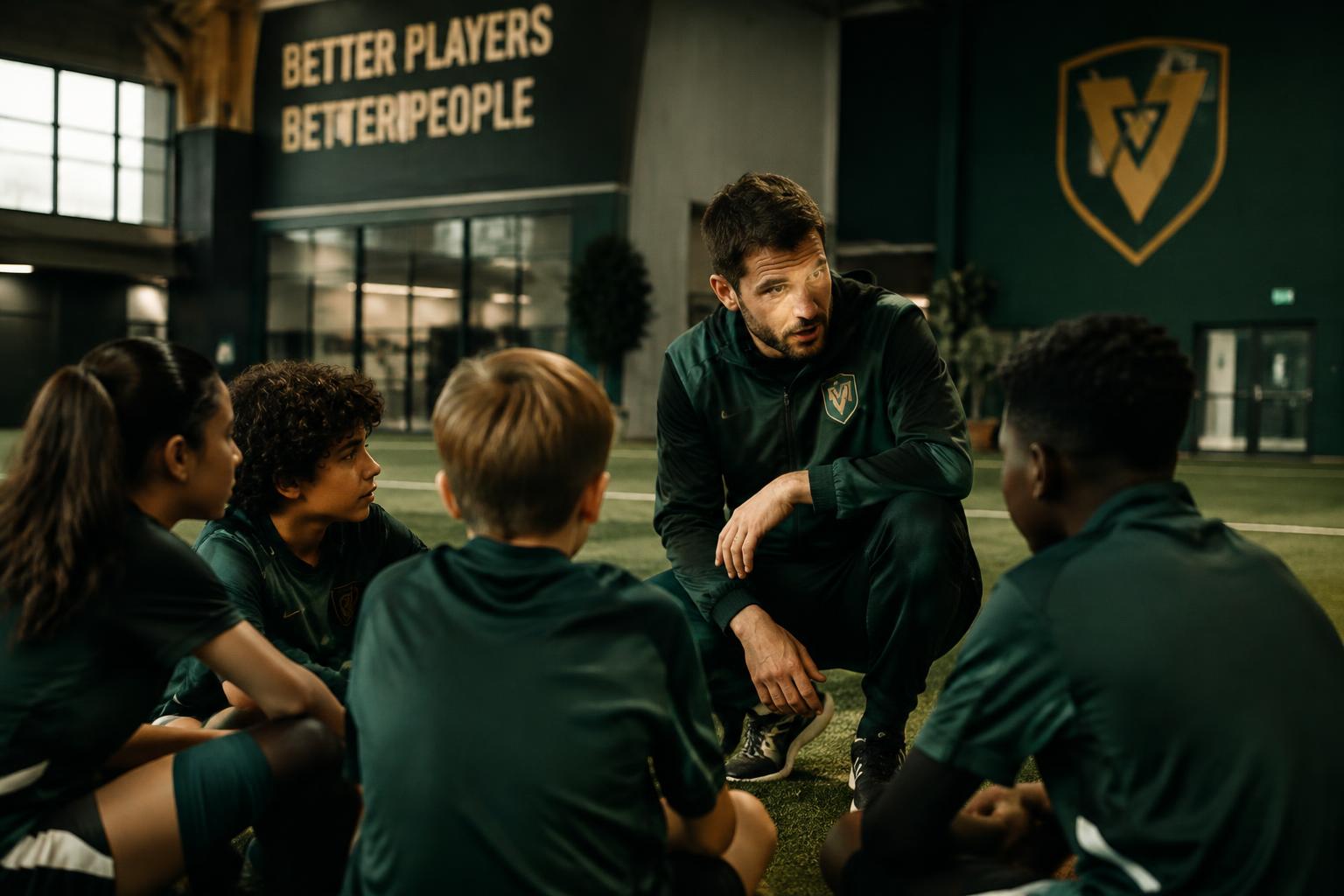
From the Neighborhood to the World: Building the Next Generation of Soccer Champions

World-class is not a place you go. It is a standard you hold, session after session, in a building three miles from your house.
There is a myth that elite development happens somewhere else — in a European academy, at an expensive showcase, under the eye of a scout who happens to be passing. The truth is more mundane and far more hopeful. Elite players are made by thousands of high-quality repetitions, coached by people who know them, over a decade. Geography is almost irrelevant. Quality and consistency are everything.
That is a claim we are willing to be held to, so let us be specific about how we do it.
Stage one: fall in love, then get technical
Our youngest groups are unapologetically about touches and joy. Small pitches, tiny teams, constant contact with the ball. We do not run laps and we do not stand children in lines. At this age the objective is a player who wants to be there tomorrow and who can already manipulate the ball with both feet.
We deliberately delay specialisation. Keepers play outfield. Defenders attack. A child who is only ever asked to do one job becomes an adult who can only do one job.
"Elite players are made by thousands of high-quality repetitions, coached by people who know them, over a decade. Geography is almost irrelevant."
Stage two: decisions under pressure
From around eleven, the coaching shifts from technique in isolation to technique inside decisions. Can you receive on the half-turn with a defender on your shoulder? Can you scan before the ball arrives? Can you make the right choice when you are tired and behind?
This is where our technology earns its place. Session video, load tracking, and individual development plans mean a player's feedback is concrete rather than vibes. "Be more aggressive" helps nobody. "You scanned twice in the first half and six times in the second — the second half is why you played better" changes behaviour.
Stage three: the competitive environment
Talent needs opposition. Our competitive teams exist so players regularly meet games they might lose, against opponents who expose exactly the weakness their development plan has flagged. Losing in a well-coached environment is one of the most productive things that can happen to a fourteen-year-old.
Alongside it, players get strength, mobility, and recovery work appropriate to a growing body. Growth-related injuries end more youth careers than bad luck does. Managing load is not coddling; it is career protection.
Stage four: the leap outward
For the players who want it, the final stage is exposure and honesty. Film that reflects real ability, a realistic list of college programs, help with academics and eligibility, and coaches who will tell a family the truth about where their player stands.
Some of our players will sign professionally. More will play in college on scholarships that change what their family can afford. Many will play adult amateur football for thirty years and coach their own children. All three outcomes are successes, and we refuse to build a program that only serves the first.
The neighborhood does not stay behind
When a player from here goes somewhere, they take the address with them. Younger kids see a name they recognise on a roster and recalculate what is possible for people like them. That recalculation is the most valuable export this academy has.
From the neighborhood to the world, and then — this part matters — back again.
Next step
See where your player fits.
Every family starts with a free evaluation — we watch your player train, talk through their goals, and recommend the right program.