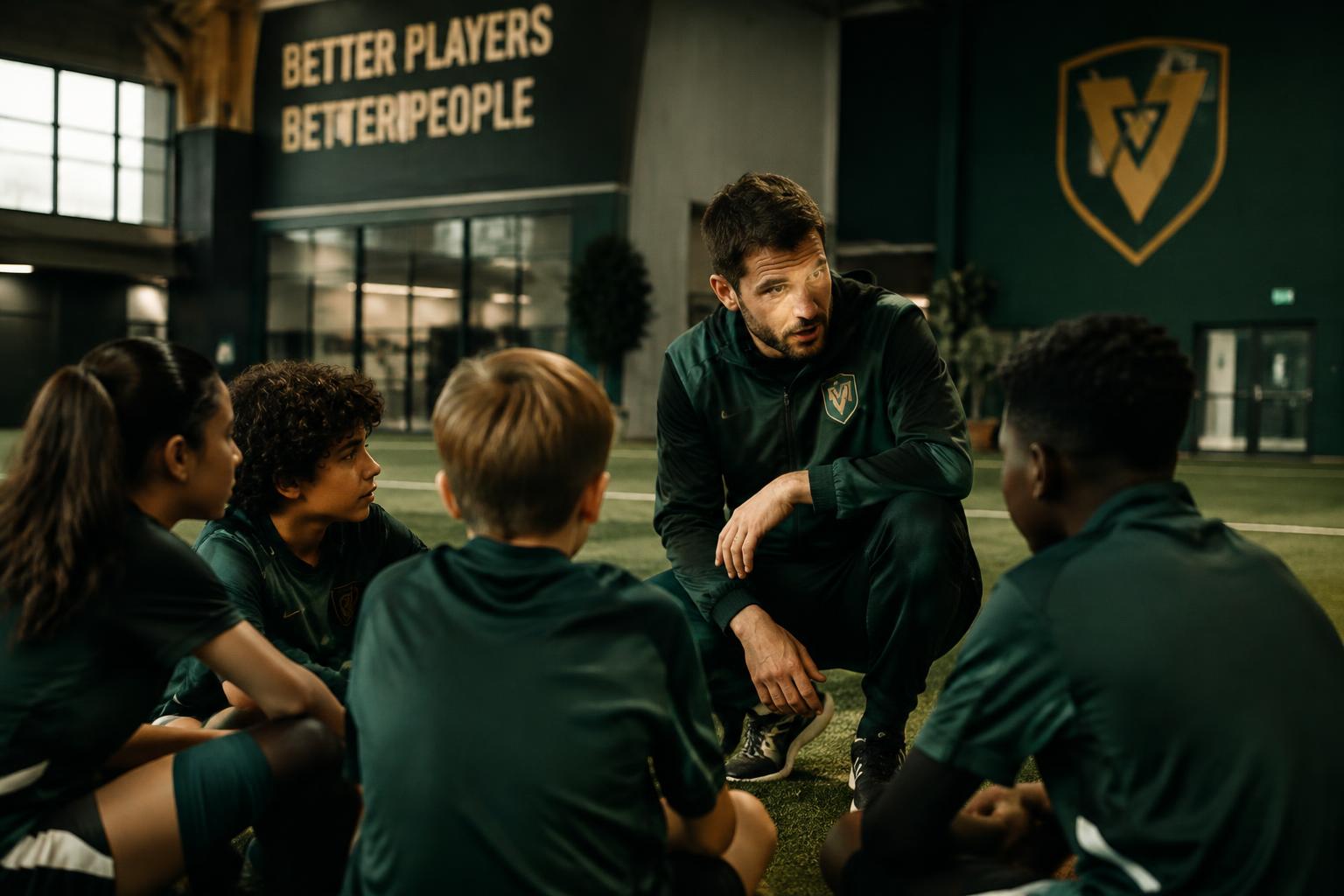
Imagine What Our Community Could Become If Every Kid Had a Field
Picture the same neighborhood ten years from now, with one variable changed: every child had somewhere safe, structured, and demanding to be after school.
Start with the evening. Right now, in this community, there are hundreds of children with nothing in particular to do between the end of school and the end of the day. In our imagined version, those hours are accounted for — coached, supervised, physically demanding, socially warm.
Everything else follows from that single change.
What changes for the kids
They are fitter, and they sleep. They belong to something with a name and a badge. They have at least one adult outside their family who knows their situation and notices when it changes. They learn that difficult things become possible through repetition, which is arguably the only lesson childhood needs to land.
And a few of them find out they are genuinely, seriously good — a discovery that never happens to a child who had nowhere to try.
"Turf and coaching are dramatically less expensive than the consequences of unoccupied adolescence, and everyone in youth work knows it."
What changes for families
Childcare pressure in the hardest hours of the week eases. Parents get a network: other adults on the sideline who share information, transport, and hand-me-downs. Households with a child in a serious program report fewer arguments about screens, because there is now something more compelling than a screen.
Families also get information. Our family portal means a parent always knows the schedule, the fees, and how their child is progressing — no chasing, no guessing.
What changes for businesses and institutions
For a local business, an academy is the most concentrated goodwill available: hundreds of families in one building every week, who notice and remember who paid for the kit. For schools, it is a partner with the trust of the same families and a direct effect on attendance and behaviour. For churches and community groups, it is a place to send kids who need structure and a place to recruit volunteers who want purpose.
For the city, it is the cheapest preventative program that exists. Turf and coaching are dramatically less expensive than the consequences of unoccupied adolescence, and everyone involved in youth work knows it.
What we need to get there
Sponsorship for teams, kits, and equipment, so fees stay low. Scholarship funding, so income never decides participation. Facility partners — schools, churches, and landowners with space we can light and program. Volunteers for camps, transport, and events. And referrals, constantly, to the families who have not yet heard of us.
If you have read this far, you are the audience. Tell us what you can contribute and we will tell you exactly which children it reaches.
Imagine it properly — and then let's go build the next field.
Next step
See where your player fits.
Every family starts with a free evaluation — we watch your player train, talk through their goals, and recommend the right program.